
The Myth of the Pure Blueprint
A screenplay can look definitive on the page. It has scene headings, controlled dialogue, described gestures, and a sequence of events that appears to promise a finished film before a camera is switched on. That appearance has encouraged one of cinema”s most persistent romantic misconceptions: the belief that directing is primarily an act of obedient translation, with the screenplay functioning as a blueprint precise enough to dictate every frame.
Production quickly dismantles that fantasy. A line that reads as brisk on paper may become laborious once actors must cross a room, find their marks, avoid a lighting stand, and project over a refrigerator hum. A supposedly intimate pause may feel false when the camera is trapped against a wall. A gesture written as a small detail may suddenly dominate the scene because an actor gives it unexpected psychological weight. The page meets bodies, architecture, weather, equipment, time pressure, and the unpredictable charge of human presence.
The on-set rewrite is therefore not automatically a betrayal of literary intention. It is an act of cinematic translation. Directors, actors, cinematographers, sound teams, and writers convert verbal ideas into duration, movement, distance, texture, and rhythm. The strongest changes do not discard the screenplay”s emotional purpose. They discover how that purpose can survive, or become sharper, once it enters physical reality.
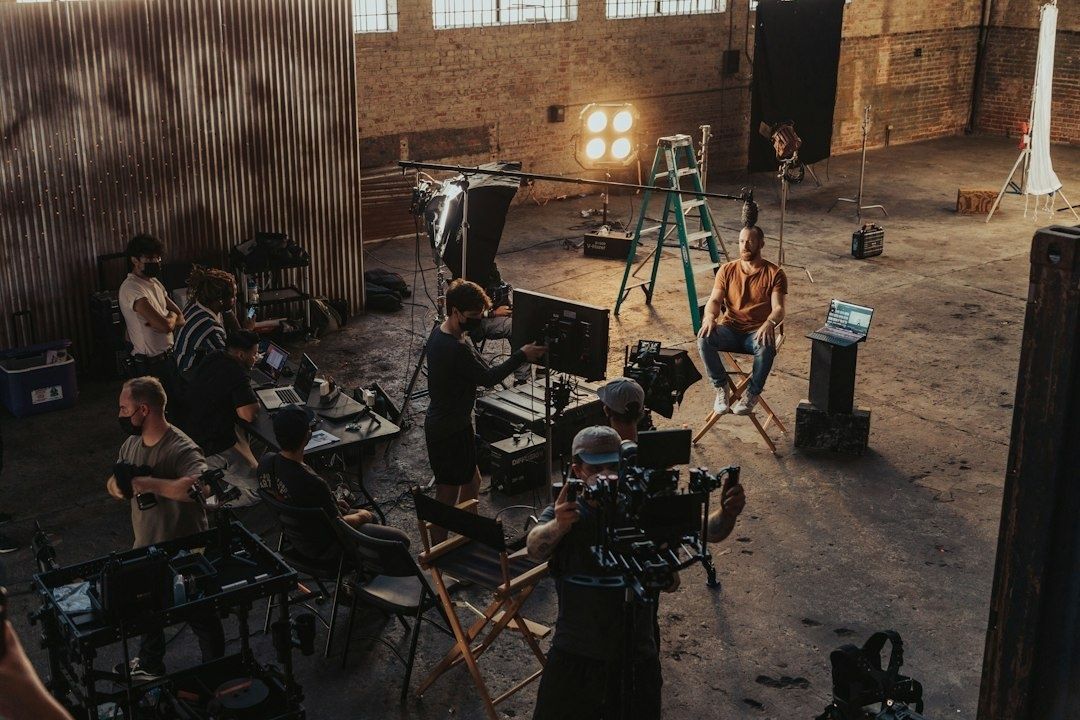
When Geography Collides With Dialogue
Dialogue has an apparent speed on the page, but speech is never only language. It is breath, hesitation, posture, eye line, interruption, and movement through an actual environment. A rapid exchange between two characters may work beautifully in a reading, then collapse when one performer must walk from a kitchen counter to a doorway while the other turns toward a window. The scene”s verbal rhythm may need to slow, divide, or yield to silence so that the geography remains legible.
Blocking also exposes the practical tension between emotional intention and production logistics. A director may want a character to circle another person during an argument, but that movement can create changing microphone distances, inconsistent lighting, unwanted shadows, or a camera position that makes the performance feel visually flat. The solution may involve cutting a line, moving the emotional turn earlier, or replacing exposition with a look across the room. In such moments, the room is not a neutral container. Its dimensions become part of the writing.
Because changes accumulate quickly, productions need a reliable record rather than a memory-based system. A marked rehearsal script, versioned digital file, and readable change log can prevent a promising adjustment from becoming a continuity error. Guidance on documenting revisions, including page references and additions on lettered pages, is outlined by The Playwrights Realm”s change-management advice. Theatre practice is not identical to film production, but its central lesson carries across both forms: improvisation becomes useful only when the team can identify what changed and communicate it clearly.
- Record the altered line, action, or beat immediately.
- Identify whether the change affects continuity, props, sound, or later scenes.
- Confirm who will distribute the revision to performers and department heads.
- Preserve the original version so the creative team can evaluate the change rather than lose its history.
This discipline matters because cognitive overload is not an abstract concern on a busy set. Crews process blocking, safety, equipment, performance, scheduling, and continuity simultaneously. Decades of research in human factors and cognitive ergonomics, including the resource Checking your browser, demonstrate how quickly high-stimulus, dynamic working environments strain working memory, divided attention, and cross-departmental communication. A change log cannot remove pressure, but it can stop pressure from turning a creative decision into narrative confusion.
The Silent Grammar of Camera Movement
Some of the most consequential rewrites happen without a new line being written. A director may cut dialogue because an actor”s micro-expression carries the information more powerfully than explanation. The camera can hold on a face after a question, move toward a character who has stopped listening, or place two figures in the same frame while refusing to give them equal visual weight. These choices turn staging into a form of syntax.
The contrast can be described simply. Scripted dialogue tells the audience what a character chooses to say, while lens choice and blocking reveal what the character cannot control. A wide shot may allow a person to appear isolated inside a crowded room. A close shot may make a blink, swallowed breath, or delayed response more significant than a paragraph of backstory. A camera that remains still can expose discomfort, while a moving camera can make emotional instability feel spatial rather than verbal.
| Scripted solution | Spatial and camera solution | Emotional effect |
|---|---|---|
| A character explains a hidden fear | The camera holds as the character avoids another person”s gaze | The fear becomes observable and unresolved |
| Two characters argue about control | Blocking repeatedly places one figure between the other and an exit | Power becomes a physical condition |
| A confession clarifies a relationship | A long take allows silence and interrupted movement to accumulate | Ambivalence replaces neat exposition |
This is why directors often choose spatial geography over spoken exposition. Space can preserve contradiction. A character may insist that everything is fine while standing far from the person they claim to trust. Someone may deliver a tender line while remaining trapped behind furniture or reflected in a distorted surface. The audience reads these competing signals instinctively, and the friction between them produces a richer experience than direct explanation.
Even the idea of “blocking” has a useful conceptual parallel in production systems. In data pipelines, a blocking transform withholds downstream output until upstream work is complete, creating a synchronization point rather than allowing every process to proceed independently. The technical description appears in the Apache Hop documentation, alongside a related explanation of waiting for selected processes to finish in its documentation on synchronizing transform copies. Cinema works differently, but the analogy is revealing: a pause in movement or information can force the audience to wait until a hidden emotional process becomes legible.
Navigating Chaos and Unplanned Set Dynamics
Film production is designed to control variables, yet cinema repeatedly gains its force from variables that refuse control. A sudden change in weather can alter the emotional temperature of a scene. A technical failure may force a director to abandon a planned dolly movement and discover that a static frame is more severe. An actor”s improvised interruption can reveal a relationship more precisely than the prepared exchange. These events are not automatically gifts, but they can become creative catalysts when the team understands what they are changing.
The challenge is to distinguish productive contingency from careless disorder. Safety procedures, equipment checks, labor requirements, permissions, and clear chains of communication are not enemies of artistic freedom. They make experimentation possible without asking workers to absorb unreasonable risk. Established industry standards, such as the Industry-Wide Labor-Management Safety Committee Safety Bulletins administered by Contract Services, alongside general guidelines from the Occupational Safety and Health Administration (OSHA), demonstrate a broader principle: complex physical operations require documented responsibilities, clear protocols, and dependable safeguards. Cross-sector policy guidance from acf.gov makes the same point: responsibilities and procedures must be explicit when conditions are complex. A film set should treat those structures as the floor beneath creative decisions, not as obstacles to be casually ignored.
When an unplanned event demands a redirection, the change can be structured rather than suppressed. The following sequence helps protect both the scene and the production:
- Identify the new condition, whether it concerns weather, performance, location, equipment, or safety.
- Ask what emotional or visual opportunity the condition creates.
- Test the smallest alteration that could preserve the scene”s dramatic purpose.
- Consult the relevant department heads before changing movement, sound, lighting, or schedule.
- Record the revised action and verify its consequences for continuity and later scenes.
This method preserves the distinction between responsiveness and impulse. A director may accept rain but change the blocking, welcome an actor”s interruption but adjust the edit, or abandon a complex camera move while retaining the intended feeling of entrapment. The production standard remains intact because the creative change is evaluated through its consequences. Spontaneity becomes a craft, not a license for confusion.
The Invisible Authorship of the Directorial Cut
The final film contains layers of authorship that rarely align perfectly. The screenwriter establishes a dramatic architecture, but the director determines how that architecture occupies time and space. Actors alter the emotional temperature through rhythm and gesture. Cinematographers shape attention with light and distance. Editors decide which hesitation survives and which explanation disappears. The finished work is therefore marked by collaboration, even when public discussion reduces its authorship to a single name.
The editing room makes the on-set rewrite visible in retrospect. Footage is assembled according to emotional truth rather than verbal completeness. A scene may work better when it begins later, ends before the expected answer, or removes a carefully written exchange in favor of a reaction shot captured between takes. This does not make the screenplay irrelevant. On the contrary, the script provides the dramatic pressure against which every later decision is measured. Its words may change, but its underlying question, conflict, or promise can continue to organize the film.
Modern production makes this authorship especially fluid. Digital workflows allow multiple versions, alternate takes, pickup scenes, and editorial experiments, while collaborative departments leave traces in every frame. The director”s signature is not simply a recognizable visual style. It is the ability to decide which accidental discoveries belong to the film, which must be rejected, and how separate contributions can be shaped into a coherent emotional experience.
Embrace the Moving Image Beyond the Page
Cinema becomes fully alive when written intention encounters presence, time, and physical space. The screenplay can propose a confrontation, but the set determines how long a character waits before answering. It can describe a room, but the room decides whether two bodies can share its tension. It can specify a gesture, but the actor may reveal a more unsettling truth through the gesture that happens just before it.
For screenwriters, this means treating the text as an invitation to collaboration rather than a closed contract. For directors, it means changing the page with precision, not vanity, and preserving the dramatic purpose beneath the altered wording. The most powerful film is rarely the one that reproduces its screenplay with mechanical fidelity. It is the one that listens to reality, recognizes what reality is offering, and transforms that encounter into form. The chasm between script and screen is not a failure to cross. It is where cinema discovers its distinctive life.