
The Myth of the Transparent Frame
A documentary frame can appear to offer reality without a veil: a face held in close-up, a room left undisturbed, a voice carrying the weight of testimony. Yet every image begins with an act of exclusion. The camera points here rather than there. A microphone captures one exchange while another fades beyond the edge of the recording. Even before editing begins, the world has been narrowed into a chosen field of vision.
Documentary cinema has therefore never been a transparent window. Framing, selective audio, lighting, performance, and narrative timing all mediate what reaches the audience. The filmmaker is not a neutral observer standing outside the event, but a conscious narrator navigating competing obligations to truth, interpretation, dramatic structure, and the people whose lives become material. For viewers, that recognition is not a reason to distrust every nonfiction film. It is an invitation to watch with greater precision.
The Architecture of the Edit Room
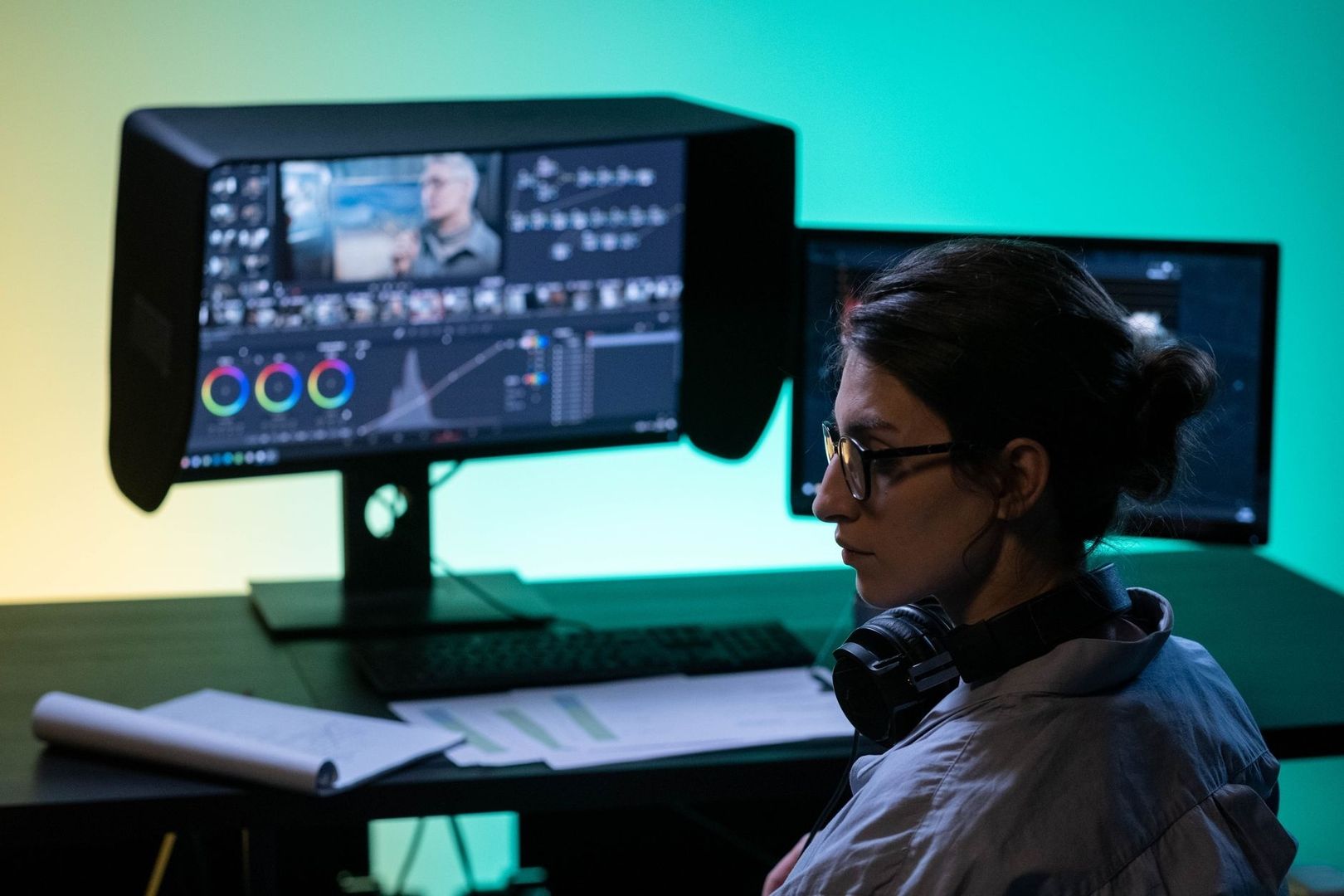
Unscripted footage does not arrive with its meaning already attached. Hours of interviews, observational scenes, archival material, pauses, mistakes, and contradictory statements must be shaped into a sequence. The edit creates relationships between images that may never have existed in the filmed world. A glance placed beside a question can suggest suspicion. A reaction shot can make a speaker appear cruel, frightened, or vulnerable. The order of scenes can transform a private difficulty into a social argument.
This is where documentary storytelling becomes both craft and ethical responsibility. Editors identify themes, establish rhythm, condense time, and decide what the audience will understand before moving to the next scene. Music can intensify grief or manufacture menace; silence can create intimacy or imply guilt. Non-chronological structures may reveal a deeper emotional truth, but they can also conceal causality. A subject shown breaking down after an interview may have been responding to something entirely unrelated, yet the cut can make the viewer read the moment as a direct consequence.
That power is why foundational media education treats interviewing, writing, production, and ethical judgment as connected skills rather than separate technical exercises. The Mass Communication (MC) curriculum at Texas State University, for example, includes interviewing for narrative and factual information, professional media writing, production practice, and responsible engagement with changing digital environments. Such training points toward a central principle: accuracy is not secured merely by recording an event. It must be protected through every stage in which recorded material is selected, described, arranged, and presented.
- Juxtaposition can create meaning by placing people, places, or statements in tension.
- Pacing determines whether an audience experiences a moment as reflective, chaotic, suspenseful, or conclusive.
- Sound design can guide emotion even when the images remain observational.
- Omission may clarify a complex story, but it can also erase context essential to fair understanding.
The most responsible edit does not eliminate interpretation. It makes interpretation accountable. That means preserving relevant context, resisting convenient caricatures, checking chronology, and asking whether a dramatic construction gives viewers a misleading impression of a real person. A documentary can be persuasive without pretending that persuasion is the same as proof.
The Dilemma of Direct Intervention
Few ethical questions are more unsettling than whether a filmmaker should intervene while events unfold. Observational cinema often draws its authority from apparent restraint. The camera watches, records, and allows situations to develop without visible instruction. Yet the presence of the camera already changes behavior, and silence can become a form of participation when someone is being threatened, manipulated, or placed in danger.
Joshua Oppenheimer”s The Act of Killing demonstrates the tension between passive recording and active interrogation. The film gives perpetrators of mass violence space to reconstruct their actions through elaborate performances, but Oppenheimer”s questions and challenges interrupt the apparent observational surface. His interventions test whether the men are presenting a heroic self-image, performing for the camera, or confronting something they have long avoided. The ethical force comes partly from refusing to let performance pass unexamined.
A contrasting problem emerges in discussions of Hot Girls Wanted, where filmmakers are criticized for remaining silent during emotionally coercive exchanges involving Tressa Silguero, her boyfriend Kendall, and her mother. In that setting, non-intervention can look less like respect for autonomy than a decision to preserve dramatic tension. The filmmaker”s responsibility is not always to rescue a subject from every difficult conversation, but neither can the camera claim innocence when its silence allows pressure to become the film”s apparent resolution.
| Documentary approach | Potential value | Ethical risk |
|---|---|---|
| Observational cinema | Allows behavior and relationships to unfold with limited visible direction | Silence may permit harm, manipulation, or a misleading performance |
| Participatory filmmaking | Reveals the filmmaker”s questions, presence, and relationship with subjects | The filmmaker may dominate testimony or steer responses |
| Performative reconstruction | Can expose memory, denial, and psychological contradiction | Reenactment may blur evidence with invention |
| Expository documentary | Provides argument, context, and historical orientation | Authoritative narration may simplify or overrule competing voices |
These categories are useful, but no mode automatically guarantees ethical practice. A quiet camera can be exploitative, while an intrusive question can protect a subject from an unchallenged falsehood. The relevant question is not simply whether the filmmaker intervenes, but why, with what power, and with what consequences for the people and evidence on screen.
Historical Truth Versus Narrative Retelling
Recorded history is especially vulnerable to the seductions of drama. A complicated archive may contain gaps, conflicting testimony, uncertain dates, and incomplete evidence. Narrative retelling prefers clear motives, decisive scenes, and emotional arcs. Those devices can help audiences enter a distant past, but they can also turn uncertainty into false certainty. When a reconstruction supplies a facial expression, a private conversation, or a final moment that no source confirms, the image may feel truthful while quietly exceeding the evidence.
The ethical problem reaches beyond cinema. Historical testimony is often preserved through stories that change as they travel across communities, institutions, and generations. A discussion of Saint Apollonia and the Ethical Foundations of Contemporary Dental Practice examines how an early account of martyrdom, transmitted by Eusebius, must be approached with care because the surviving evidence is limited and lacks independent confirmation. The value of the account does not depend on treating every detail as verified fact. It can also be read as a record of how societies represented pain, violence, care, and moral obligation.
That distinction matters for filmmakers. A testimony can be historically uncertain and still culturally significant, but its uncertainty must remain visible. Researchers should identify primary sources, distinguish direct evidence from later interpretation, and resist presenting a compelling version as the only possible version. Creators have a responsibility to protect the difference between what is documented, what is remembered, what is inferred, and what has been dramatized for narrative purposes.
Historical fidelity does not require lifeless filmmaking. Reenactments, carefully labeled composites, atmospheric sound, and selective compression can all serve understanding when their status is clear. The danger begins when emotional resonance is used to smuggle invention into the category of fact. Sensationalism may produce immediate impact, but it can damage the public record and reduce real suffering to a set of marketable images.
Synthetic Realities and Emerging Technologies
Generative artificial intelligence has introduced a new layer of mediation into nonfiction cinema. Restoration tools can clarify damaged footage, voice-cloning systems can recreate speech, and image generators can produce scenes that resemble archival photographs. Reenactments may protect vulnerable subjects by replacing identifiable faces with simulated human figures. These applications can be constructive, but they also challenge the assumption that an image or voice in a documentary necessarily originated from a camera or microphone pointed at a historical event.
The Archival Producers Alliance, a volunteer organization of more than 300 documentary producers and researchers, responded to these concerns with ethical guidelines announced at the Camden Film Festival. Reported by The Guardian, the guidance emphasizes primary sources, transparency, legal awareness, and ethical treatment of human simulations. It does not call for rejecting the technology outright. Instead, it asks filmmakers to consider algorithmic bias, preserve original source forms where possible, disclose alterations, and credit the tools, companies, and creators involved.
For audiences, synthetic material should prompt questions rather than automatic panic. The key issue is not whether a computer contributed to an image, but whether the film makes that contribution legible and whether the result distorts the historical record.
- Ask whether the film clearly labels generated, restored, reconstructed, or altered material.
- Look for information about the original source and whether the unaltered version remains available.
- Consider whose voice, appearance, or identity has been simulated, and whether consent or protection was addressed.
- Examine whether synthetic elements clarify documented evidence or create a scene that no source supports.
- Check whether the production credits disclose relevant tools, methods, and editorial decisions.
Transparency must extend beyond the viewer. Subjects, production teams, legal and insurance partners, distributors, and future researchers all need to understand what has been made and altered. Without that chain of disclosure, synthetic material can acquire the false authority of an archive. With it, technology can remain a visible instrument of interpretation rather than a concealed substitute for evidence.
Sharpening the Critical Eye Behind the Screen
Documentary is an interpretive artistic medium, not an unblemished evidentiary court. Its power comes from shaping reality into patterns that audiences can see, feel, and discuss. That power does not disappear when a filmmaker acknowledges subjectivity. It becomes more trustworthy when framing, editing, intervention, reconstruction, and technological alteration are treated as choices with consequences.
The viewer”s task is therefore active. Listen for what the score tells you to feel, notice which voices receive context, question how chronology has been arranged, and distinguish testimony from corroborated evidence. Ask what remains outside the frame and whose interests are served by the film”s apparent certainty. Nonfiction storytelling reaches its greatest force when audiences engage with it neither as passive consumers nor as reflexive skeptics, but as attentive witnesses who hold filmmakers accountable to the realities they portray.